



Flood risk assessment for minor development
A flood risk assessment for a minor development such as an extension or small conversion.
About this service
If your home sits in a flood zone, a planning application for an extension, basement or small conversion will often need a flood risk assessment. For minor development, the assessment can be proportionate: it does not need complex modelling, but it must show that you understand the flood risk to your property and that the work will not make things worse. We prepare these assessments for homeowners and small developers across London.
The Environment Agency maps flood zones based on the risk of flooding from rivers and the sea. Flood Zone 1 has the lowest probability, Flood Zone 2 a medium probability and Flood Zone 3 the highest, with the functional floodplain separately identified as Zone 3b. Along the tidal Thames, many properties sit in Zone 3 but are protected by flood defences, so the assessment needs to explain the residual risk if those defences were breached or overtopped.
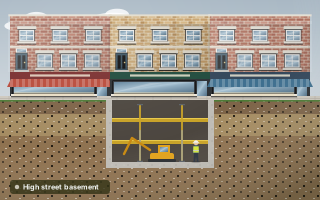
A flood risk assessment also looks beyond rivers and the sea. In London, surface water flooding during intense rainfall and sewer flooding are often more likely than river flooding. Basements are particularly vulnerable to both. If your project includes a basement, our basement guide explains the wider issues, and the council may ask for a Basement Impact Assessment as well.
When you need it
- Your site is in a flood zone and you're applying for planning
- The council has asked for a flood risk assessment
What's included
- Review of flood zone and data
- Assessment of flood risk to and from the development
- Mitigation measures
How it works
- Check the flood zone and dataWe check the Environment Agency flood maps, surface water and reservoir mapping, and the council's strategic flood risk assessment and any local flood records for your site.
- Assess the riskWe assess flood risk from each source, including rivers, tidal Thames, surface water, groundwater and sewers, both to the property and from the proposed works to others.
- Propose mitigationWe recommend practical measures such as raised floor levels where feasible, flood resilient materials, non-return valves on drains, safe refuge upstairs and signing up to flood warnings.
- Issue the assessmentWe issue a concise flood risk assessment written for the planning officer, referencing the relevant Environment Agency standing advice and the council's local policies, with clear recommendations it can attach as conditions.
What you receive
Flood zones, standing advice and who decides
For many minor extensions, the Environment Agency publishes standing advice rather than commenting on each application. That advice sets out what the council expects, typically floor levels no lower than existing and flood resilience measures where levels cannot be raised. The council's planning team makes the decision. The Lead Local Flood Authority, which in London is the borough council, leads on surface water and groundwater flooding and may comment where those risks are significant.
Some councils also identify critical drainage areas where surface water problems are known, and may want an assessment even in Flood Zone 1. A change of use that creates a more vulnerable use, such as turning a shop into a basement flat, can face tougher scrutiny than a simple extension. If your project could fall outside the minor category, our major development flood risk assessment covers the fuller scope.
Projects that used this service
Frequently asked questions
Do I need a flood risk assessment for a house extension?
You usually need one if your property is in Flood Zone 2 or 3 and you are applying for planning permission, including for many extensions. Some councils also ask for one in Flood Zone 1 where there is a known surface water problem. Extensions under permitted development do not need one. Check the flood map for planning and your council's validation list to confirm.
What are flood zones 1, 2 and 3?
They are Environment Agency classifications of the probability of flooding from rivers and the sea, ignoring defences. Flood Zone 1 is low probability, Flood Zone 2 is medium and Flood Zone 3 is high. Zone 3 is split into 3a, high probability, and 3b, the functional floodplain where water needs to flow or be stored in a flood. The zones do not cover surface water flooding.
How much does a flood risk assessment cost for an extension?
Our minor development flood risk assessments start from £450 + VAT. The fee depends on the flood zone, the sources of risk and how much local data needs reviewing. Basements and changes of use can need more work than a simple ground floor extension. We confirm a fixed fee in writing before starting, so you know the cost upfront.
Can I build a basement in a flood zone?
It is often difficult. Basements are vulnerable to river, surface water, groundwater and sewer flooding, and planning policy is generally restrictive about basement bedrooms or self-contained basement flats in Flood Zone 3. Basement extensions to existing homes may be acceptable with suitable mitigation, such as internal access to upper floors and non-return valves. The council will confirm its policy for your site.